
An indexable page with very little text is hard to understand. There is not enough on it to tell what it offers, who it is for, or what to do next. SiteScore flags indexable pages under 300 words as thin. The number is a line for the check, not a law about how long every page must be.
What the 300 word line means
Three hundred words is about half a printed page. A homepage that is only a slogan and a button often falls under it. A service page that names the service and stops often falls under it. The flag means: a person, and a system summarising the page, does not have much to work with.
A short page can still be the right page. A pricing table, a contact page, or a tool can be useful without an essay. If the page is indexable and almost empty, the useful move is to add the facts, not to repeat a sentence until the counter ticks over. Filler is obvious to read and it does not answer the question that brought someone there.
Add the facts, not padding
- Who the page is for, in one or two sentences.
- What is included, and what is not.
- Where you work, or where the thing ships.
- How to take the next step, with a real link.
- One proof: a process, a material, a time, a price range.
Pages you have marked noindex are not counted as thin. A cart, a thank-you page, or a filtered search URL should stay out of the index, and it should not be stuffed with text to clear a content warning. Canonicals, sitemaps, and noindex is the guide for those pages.
If the average word count is under 300, the content category is telling you the site is mostly slogans. Fix the important indexable pages first.
Work from the pages that already get visits, or that you most want found. A homepage and the main service pages matter more than a forgotten draft. Write the way you would explain the offer to a customer on a call: what it is, who it is for, what happens next. Then stop. Three hundred words of that is plenty for the check, and it is more useful than a thousand words that circle the same claim. If a page should not be in the index at all, mark it noindex instead of padding it.
How content is weighted
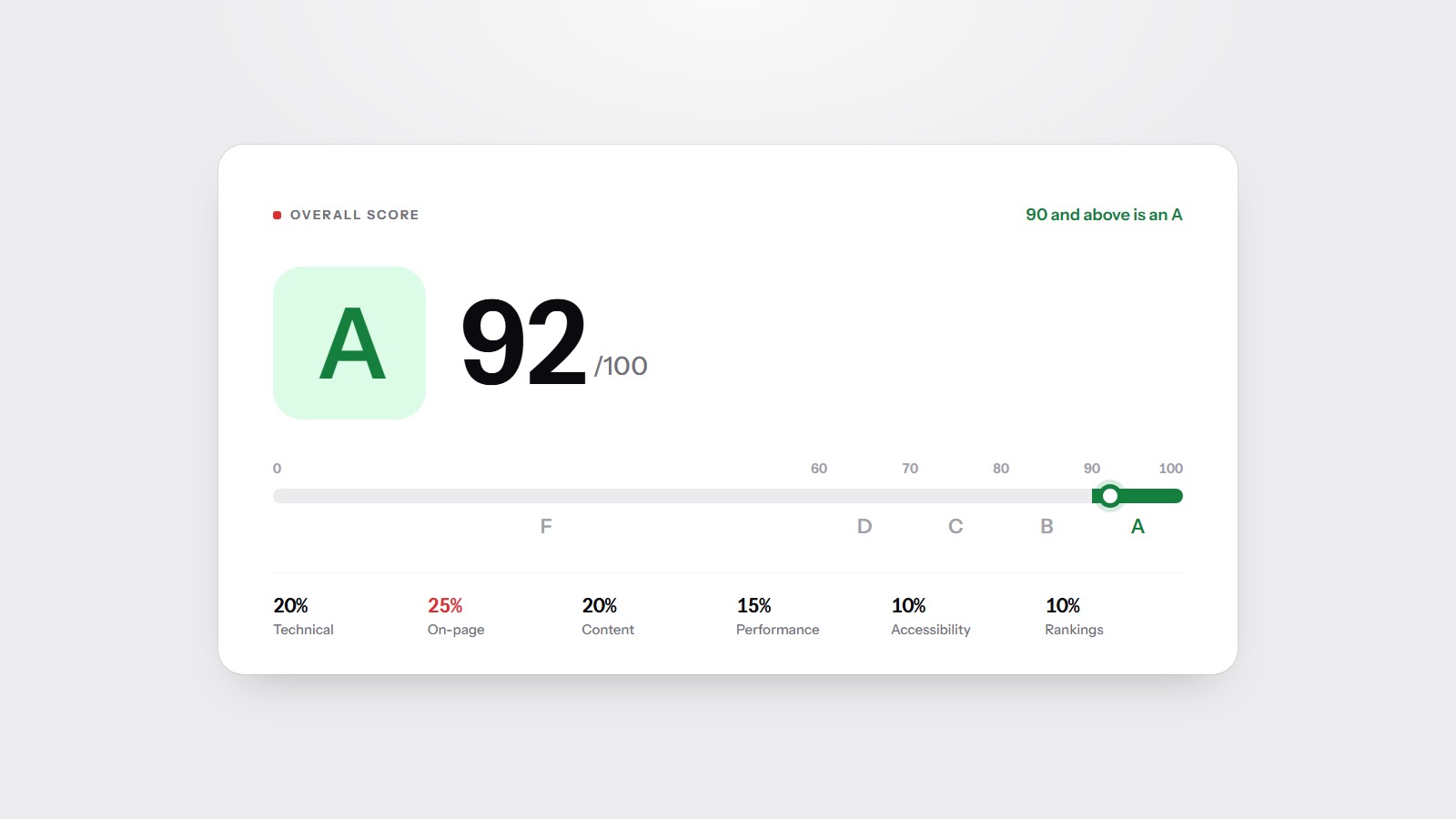
Content is 20 percent of the overall score. Thin indexable pages are the main signal in that category. Clearing them moves the content number. It does not rewrite the technical or on-page numbers. The letter is the weighted total, which the score guide explains, and the checks are listed on the methodology page.
A homepage-only pass can already show a thin homepage. A full crawl is what counts thin pages across the site. The free scan is the homepage pass, and it is the right place to start.