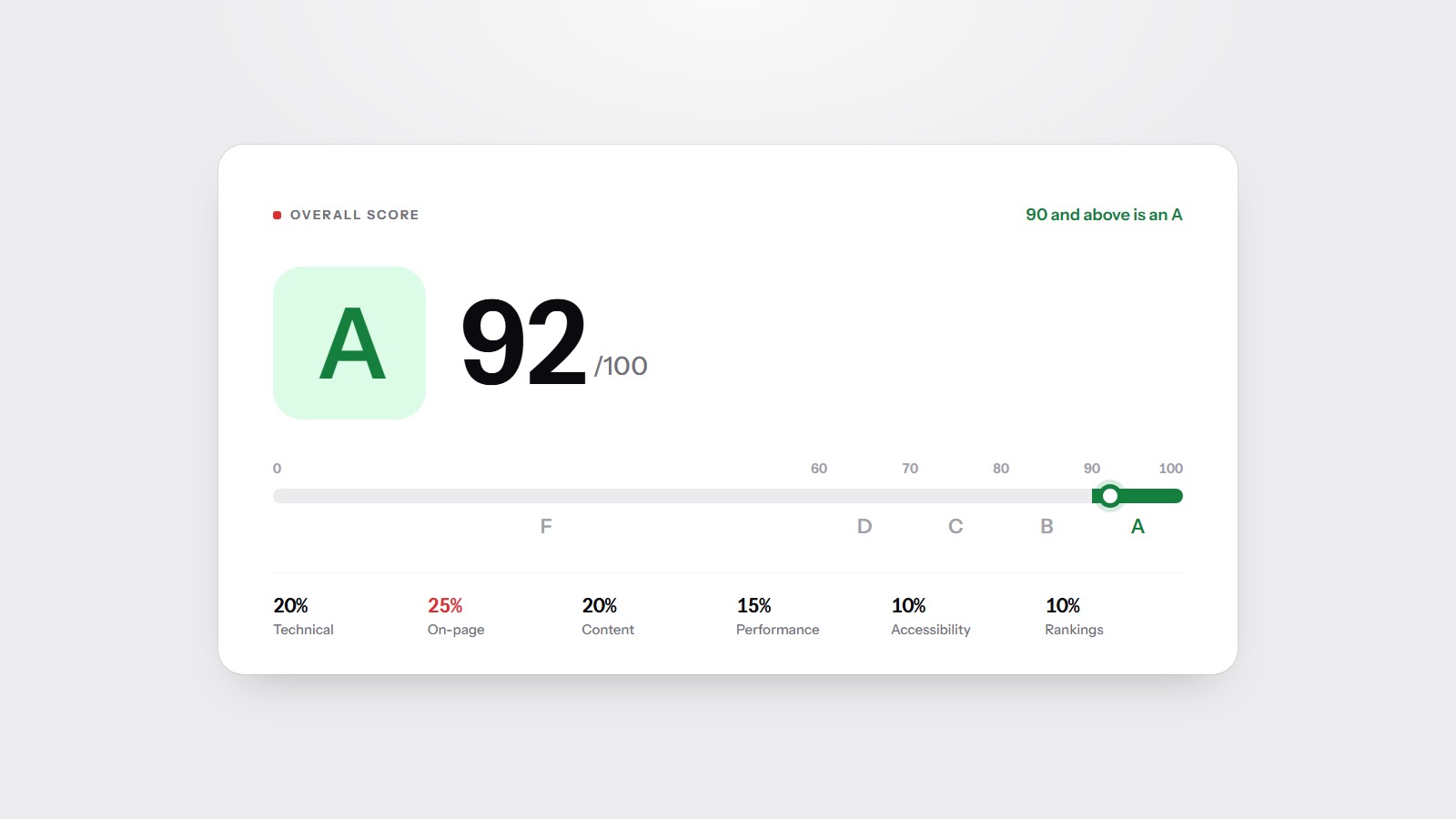
AI-search readiness is a separate grade from the letter on your report. It does not change the overall score. It answers a narrower question: if a system wants to quote your site in an answer, can it fetch the page, tell who you are, and read the words without running JavaScript?
Two kinds of crawler, and only one is scored
robots.txt can name specific bots. SiteScore splits them. Answer-engine crawlers fetch a page because someone asked a question, or because they build a search index. Blocking them removes you from those answers, so access is scored, up to 30 of the 100 AI-search points.
- OAI-SearchBot and ChatGPT-User, for ChatGPT search and for a page ChatGPT fetches because a person asked.
- PerplexityBot and Perplexity-User.
- Claude-SearchBot and Claude-User.
- Googlebot, for Google Search and AI Overviews. Bingbot, for Bing and Copilot. Applebot, for Siri and Spotlight.
Training crawlers are listed and never penalised. Blocking them is a normal business choice. That list includes GPTBot, ClaudeBot, Google-Extended, Applebot-Extended, CCBot, Meta-ExternalAgent, and Bytespider. Google-Extended does not control ordinary Google Search. Blocking it is not the same decision as blocking Googlebot.
A Disallow aimed at Googlebot, or a Disallow: / that covers everyone, removes the site from Google. A Disallow aimed only at GPTBot does not. Read the user-agent line before you celebrate a block.
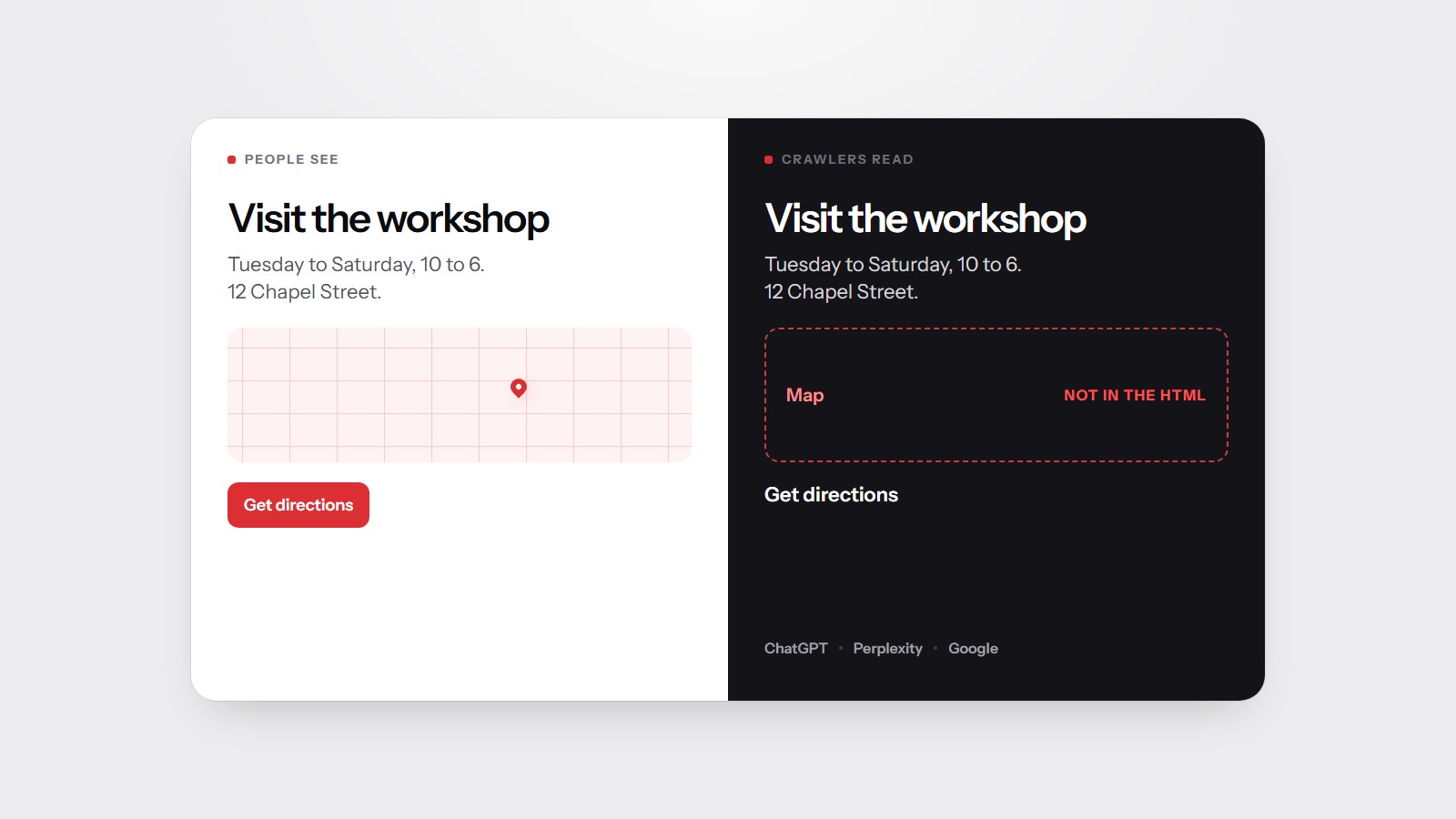
The words have to be in the HTML
Many answer-engine crawlers do not run your JavaScript. They read the HTML the server sent. If the heading, the prices, and the article appear only after a script runs, those crawlers see an empty page. This check is worth 20 points. When a browser renderer is available, the scan compares the words in the raw HTML with the words after rendering. When it is not, it estimates from the raw HTML alone.
The practical standard is dull and reliable. The main text, the one H1, and the links to your important pages should be in the first response. Use JavaScript for interaction, not for publishing the sentence you hope to be quoted.
Say who runs the site, in the page and in schema
Identity schema is worth 20 points. The homepage should include Organization, LocalBusiness, or Person JSON-LD with a name, a url, a logo, and sameAs links to the profiles you actually control. A local business should also include an address and a telephone number. If the name in the schema does not appear in the title or the H1, the check takes 4 points off. The schema and the visible page have to agree.
Semantic structure is the last 15 points: a main element, a header or footer, a nav, exactly one H1, headings in order, and a lang attribute on the html element. These are the hooks a parser uses to find the content and ignore the chrome. They also help people who are not using a standard browser layout.
What this grade is not
It is not a ranking factor inside the letter grade, and it is not a claim that an answer engine will cite you. Citation depends on whether the page is a useful source for that question. The grade only measures whether you have made the page readable and attributable. An llms.txt file is one of the checks, worth 15 points, and it has a limit you should know before you write one. That limit is the whole of what llms.txt is and what it will not do.
If the site is missing from ordinary Google results, fix fetch and index instructions first. Why a finished site can be missing is the shorter path. The AI-search grade will still be there afterwards, as a second number next to the letter. What that letter means keeps the two scores apart on purpose. The points behind the AI-search grade are on the methodology page. You can see both grades for your homepage with the free scan.